
A Shopify store can look polished, offer strong products, and still struggle to generate meaningful organic traffic. We see this with stores where design and usability received plenty of attention during development, but search visibility was treated as something to address after launch. The problem is rarely the storefront alone. It is usually the SEO foundation underneath it.
Shopify makes it relatively easy to launch and manage an ecommerce store, but strong organic visibility still requires deliberate planning. That is why Shopify development and Shopify SEO should work together rather than being treated as separate projects.
At OptiWeb Marketing, we work with Shopify businesses in Montreal, Quebec, and across Canada, where technical performance, product visibility, search intent, and bilingual requirements can all influence organic growth. This guide explains the Shopify SEO priorities that matter in 2026, including platform-specific technical issues, product and collection optimization, content strategy, and the bilingual search opportunity Montreal businesses cannot afford to overlook.
Why Shopify SEO Is Different From Other Platforms
Shopify is not WordPress, and applying the same SEO checklist to every CMS overlooks platform-specific issues that can affect ecommerce visibility.
Shopify stores rely heavily on product pages, collections, themes, apps, and filtering systems. As a store grows, these elements can create unnecessary URL variations, repetitive content, performance issues, or weak page structures if they are not managed carefully. Apps can also add scripts and functionality that affect page performance long after they were originally installed.
During a Shopify SEO audit, the important question is not whether the platform is « SEO-friendly. » It is whether the individual store has been structured and optimized to work effectively within Shopify’s framework.
Fix Your Store’s Technical Foundation First
Before investing heavily in content or link building, make sure the store’s technical foundation is working properly. When we audit Shopify stores, we look beyond basic crawlability and review platform-specific issues that can create duplicate URLs, waste crawl resources, slow important pages, or make it harder for search engines to understand products and collections.
Collection-Aware Product URLs
Shopify can make the same product accessible through URLs such as /collections/boots/products/winter-boot and /products/winter-boot. These URL variations need to be reviewed carefully so search engines consistently understand which version should be treated as the primary product URL.
Tag Pages, Filters, and Variant URLs
Collection tags, filter parameters, and product variant URLs can create additional crawlable URL combinations without adding meaningful search value. Review which URLs should be indexed and make sure unnecessary variations are not competing with important product and collection pages.
Theme and robots.txt.liquid
Shopify provides control over the robots.txt.liquid template, but changes should be made carefully. Theme structure, crawl directives, canonical implementation, and app-generated URLs should be reviewed together rather than using robots.txt as a quick fix for broader indexing problems.
Core Web Vitals
Performance issues often come from heavy themes, oversized media, third-party scripts, and unnecessary apps. Pay particular attention to Largest Contentful Paint (LCP) and Interaction to Next Paint (INP), especially on mobile product and collection pages where performance can directly affect the shopping experience.
Product Structured Data and Merchant Center
Product pages should provide clear, accurate product information that search engines and shopping platforms can understand. Review Product structured data for important details such as pricing, availability, and product identifiers, and keep product information consistent with the data submitted through Google Merchant Center.
Build a Bilingual Shopify SEO Strategy for Montreal
This is where Montreal and Quebec stores face an SEO challenge that many generic Shopify guides barely address.
Customers in Quebec search and shop in both English and French. A store that provides a strong experience in only one language limits its ability to reach customers searching in the other. Simply translating pages is not enough either. Search behaviour, terminology, product descriptions, metadata, and customer expectations can differ between English and French audiences.
Shopify supports multilingual and market-specific experiences through Shopify Markets and language features. When markets, URLs, and languages are configured correctly, Shopify can automatically generate hreflang tags and other international SEO elements that help search engines understand the relationship between language versions. The SEO work is therefore not about manually adding hreflang to every page. It is about making sure the market and language configuration is correct and that custom themes or apps are not interfering with it.
The content itself matters just as much as the technical configuration. French product titles, collection copy, metadata, and supporting content should be reviewed for the Quebec audience instead of relying blindly on word-for-word machine translation. Shopify itself recommends adapting content for individual markets rather than treating translation as the end of localization.
For Montreal ecommerce businesses, bilingual SEO should be planned from the beginning. It connects directly with the same English and French considerations that influence local SEO in Montreal and gives both customers and search engines a clearer experience.
Practical Bilingual Shopify SEO Setup for Quebec
For a bilingual Shopify store, French should be treated as a complete search experience rather than a translated copy of the English storefront. A practical setup usually means keeping French content within a dedicated /fr/ subfolder and localizing the elements that influence both search visibility and the customer experience.
French pages should use properly translated URL handles, page titles, meta descriptions, headings, product and collection copy, and image alt text where appropriate. The terminology should reflect how customers in Quebec actually search and shop rather than relying on direct translations written for audiences in France.
Avoid automatically redirecting visitors based only on their IP address. Customers and search engines should be able to access the appropriate language version clearly, with visible language-selection options and consistent links between equivalent English and French pages.
Quebec French vs. France French
Some ecommerce terms and product language differ between Quebec and France. A short terminology table should be reviewed for the store’s specific industry before publication so the French version reflects language customers in Quebec naturally use.
Quebec Law 14: Businesses operating in Quebec should also review the French-language requirements that apply to their websites and ecommerce content. These requirements depend on the business and its circumstances, so this guide should not be considered legal advice. Consult an appropriate legal professional when determining your compliance obligations.
Optimize Product and Collection Pages Properly
Product and collection pages sit closest to the purchase decision, which makes them some of the most commercially important pages in a Shopify SEO strategy.
Write useful, unique product descriptions. Avoid copying supplier descriptions across the store. Explain what makes the product relevant, include specifications customers actually need, answer common purchase questions, and incorporate search terminology naturally.
Build collection pages around real search intent. A Montreal clothing retailer, for example, might have a collection targeting a category such as women’s winter boots. The page should do more than display a product grid. Useful introductory copy, relevant filtering, clear product organization, and supporting information can help both customers and search engines understand what the collection offers.
Use descriptive image alt text. Shopify stores are image-heavy, so meaningful alt text supports accessibility and gives search engines additional context about product imagery. Describe the image accurately rather than filling the field with repeated keywords.
Keep product handles understandable. Product and collection handles should describe what the page contains rather than retaining unclear draft names or internal references wherever they can reasonably be improved.
Strengthen internal linking. Blog articles, buying guides, collections, and related products should connect logically. Internal links help search engines understand the relationship between pages while giving customers a natural path from research to purchase.
Create Content That Supports Products, Not Content for Its Own Sake
One mistake ecommerce businesses make is treating the blog as a separate marketing activity instead of part of the store’s search strategy.
A Shopify blog should answer questions that potential customers ask before they are ready to buy. A furniture store might publish guidance about choosing materials, sizing, maintenance, or product comparisons. A beauty retailer might answer ingredient, usage, or product-selection questions. Those articles can capture informational searches and then guide readers toward the relevant collections or products.
This is how topical authority develops. Instead of publishing unrelated posts simply because a keyword has search volume, build content around the categories and products that generate business value.
The internal linking works in both directions. Blog content should point toward relevant commercial pages, while important collections can link to supporting resources where they genuinely help shoppers make a decision.
Prepare Your Shopify Store for AI Shopping Assistants
Product discovery is expanding beyond traditional search results. AI-powered shopping experiences can help customers research products, compare options, and make purchase decisions without following the traditional search journey. For Shopify businesses, this makes accurate and well-structured product information increasingly important.
Shopify’s Agentic Storefronts are part of this shift toward AI-assisted commerce, where product information can be surfaced through AI-driven shopping experiences. Stores should make sure their product titles, descriptions, pricing, availability, variants, images, and other important product details are complete, accurate, and consistent.
Structured data also plays an important role. Product schema helps search engines and other systems understand key product information, while an accurate Google Merchant Center feed supports product visibility across Google’s shopping ecosystem. Conflicting or incomplete information across the website, structured data, and product feeds can make products harder for these systems to interpret reliably.
At OptiWeb Marketing, we recommend treating AEO and ecommerce SEO as connected strategies rather than separate initiatives. A technically sound Shopify store with clear product information, useful content, structured data, and consistent feeds is better prepared for both traditional organic search and emerging AI-assisted product discovery.
Common Shopify SEO Mistakes We See
Relying on Too Many Apps
Installing another app is often the easiest way to add functionality, but every addition should have a clear purpose. Multiple apps performing overlapping SEO, tracking, or optimization functions can create unnecessary complexity and may introduce conflicting implementation or additional scripts.
Review the app stack regularly. If an app is no longer actively contributing to the store, determine whether it still needs to remain installed.
Ignoring the Blog Entirely
Stores that publish only product and collection pages limit the range of searches they can realistically target. Customers do not begin every buying journey with a product name. They search for comparisons, recommendations, solutions, sizing information, maintenance advice, and answers to specific problems.
Without useful informational content, competitors can capture those earlier searches and introduce customers to their products first.
Launching a Migration Without a Redirect Plan
A move to Shopify can change URLs. If valuable old URLs begin returning 404 errors instead of redirecting to the closest relevant new page, the store can lose traffic and authority those pages previously earned.
A redirect map should therefore be part of the migration plan, not something created after rankings and traffic have already dropped.
Treating French Content as an Afterthought
For a Montreal or Quebec store, adding French pages late and relying on unreviewed translations creates both a customer-experience and search-visibility problem. The French version needs the same strategic attention as the English version, including localized content, metadata, internal links, and market configuration.
Bilingual SEO works best when both language experiences are planned together.
Get a Free 15-Minute Shopify SEO Review
Running a Shopify store in Montreal and unsure what is limiting your organic visibility? OptiWeb Marketing offers a free 15-minute review to identify key SEO opportunities across your store’s technical setup, product and collection pages, and bilingual search experience.
Book Your Free 15-Minute Review
Measure Shopify SEO by Business Results, Not Rankings Alone
Rankings and organic traffic are useful indicators, but ecommerce SEO ultimately needs to support sales.
Track which organic landing pages contribute to purchases and revenue. Review which product and collection pages attract qualified search traffic, where visitors leave the buying journey, and which informational pages assist customers before a purchase. Google Search Console and analytics data can also reveal pages receiving impressions but failing to attract clicks, as well as categories gaining visibility without producing meaningful engagement.
Branded search growth is another useful signal to monitor over time because it can indicate that more customers are actively looking for the business rather than discovering it only through generic product searches.
A store ranking for many keywords that rarely contribute to sales can be less valuable than one attracting a smaller volume of highly relevant visitors who become customers. The goal is not more SEO metrics. It is stronger organic business performance.
Real-World Ecommerce SEO Example
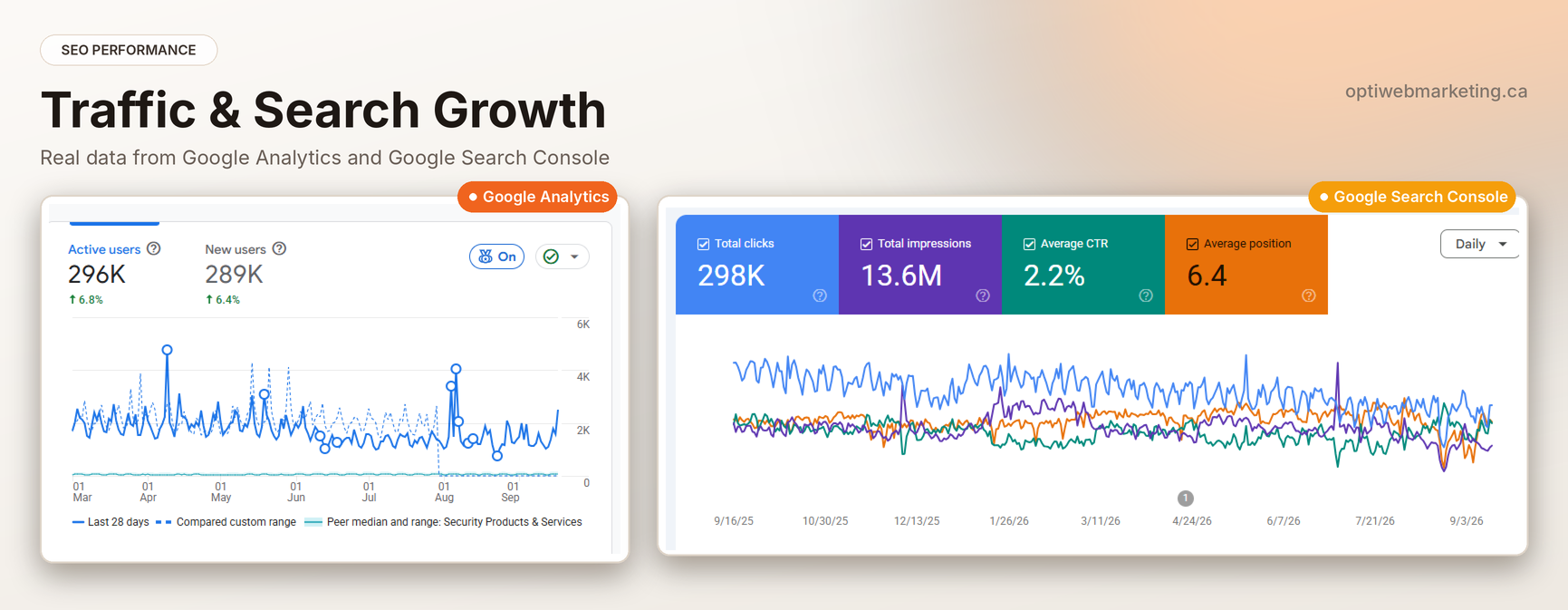
A specialized ecommerce retailer was struggling to turn its existing search presence into stronger organic visibility and growth. OptiWeb Marketing reviewed the website’s SEO performance, identified opportunities across its technical setup, content, and search visibility, and implemented targeted improvements to strengthen its organic presence.
The Search Console and Analytics data shown here reflects the performance recorded after these improvements, demonstrating how a more structured SEO approach can support stronger visibility and qualified website traffic.
Where Should a Shopify Store Start?
If an established Shopify store has little organic growth to show for its time online, start by understanding what is holding it back rather than immediately publishing more content. A technical audit can identify crawlability, indexing, performance, architecture, content, and internal-linking issues that limit the value of everything added afterward.
For a new bilingual Montreal store, plan the English and French structure before launch. Configure Shopify Markets and languages correctly, determine how content will be localized, and make sure both versions of the store provide a complete customer experience. Shopify automatically handles important international SEO elements such as hreflang when markets and languages are configured properly, but the underlying strategy and content still require deliberate work.
At OptiWeb Marketing, our Shopify SEO work begins by reviewing the store’s technical foundation, product and collection structure, search visibility, content opportunities, and bilingual setup where relevant. We then identify the issues and opportunities that deserve priority rather than applying the same checklist to every store. Contact OptiWeb Marketing to discuss where your Shopify store is losing organic visibility and what should be addressed first.
If you are still building your SEO foundation, our complete guide to SEO optimization explains the core principles behind the strategies covered here.
You can also explore our case studies to see how OptiWeb Marketing approaches SEO and digital growth strategies for businesses across different industries.
 Table of Contents