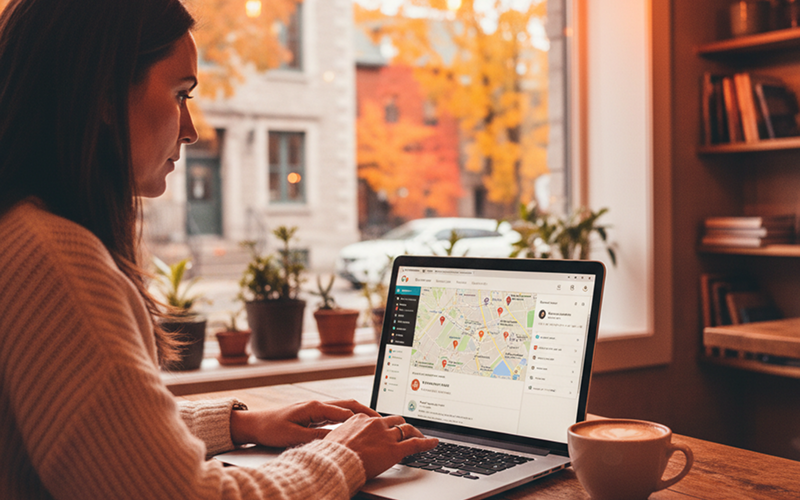
When someone searches for a business in Montreal, they may decide who to contact before visiting a single website. Google Search and Maps can already show them reviews, hours, photos, services, directions, and other information they need to compare local businesses.
If your Google Business Profile is incomplete, outdated, or poorly aligned with what customers are searching for, you can lose that opportunity before they ever reach your website.
For Montreal businesses, local visibility comes with another layer of complexity. Customers search across Montreal and surrounding communities, and they may search in English or French depending on their needs and preferences.
A strong profile therefore needs to do more than exist. It needs to accurately represent the business, support the customer’s decision-making process, and work alongside the website and a broader local SEO strategy.
At OptiWeb Marketing, we do not treat Google Business Profile optimization as a standalone checklist. The profile, website, reviews, local business information, content, and bilingual search experience need to reinforce one another. This guide explains how Montreal businesses should approach that process in 2026.
What Is Google Business Profile Optimization?
Google Business Profile, formerly Google My Business, allows eligible businesses to manage important information that can appear across Google Search and Google Maps. Depending on the business, that information can include the company name, address or service area, phone number, website, opening hours, categories, services, photos, reviews, attributes, and updates.
Optimizing the profile means making those details accurate, complete, useful, and consistent with the business customers find elsewhere online. It does not mean inserting keywords into every available field. The objective is to give Google clear information about what the business does and give potential customers enough useful information to decide whether it meets their needs.
This distinction matters because Google Business Profile is only one part of search visibility. Businesses that want to understand how local optimization connects with technical SEO, content, search intent, and authority can also refer to our complete SEO guide.
Why Google Business Profile Matters for Local SEO
A search such as “emergency plumber Montreal” has a very different intent from a general search about plumbing. The person is looking for a relevant business that can solve a problem in a particular area, which is why local results can become an important part of the customer journey.
Google explains local rankings primarily through relevance, distance, and prominence. Relevance reflects how closely a business matches the search, distance considers how far the business is from the searcher’s location or the location specified in the query, and prominence considers how established or well-known the business appears based on information Google has about it, including signals such as links and reviews.
A business cannot control where every potential customer searches from, but it can control the quality and accuracy of much of the information Google and customers use to understand the business. That is why our Local SEO services in Montreal consider the profile alongside the website, reviews, local relevance, and other search signals rather than treating Maps visibility as an isolated objective.
1. Start With Accurate Business Information
Before working on categories, reviews, photos, or other optimization opportunities, make sure the basic business information is correct. The business name, address, phone number, website, regular hours, special hours, and service area where applicable should represent the business as it actually operates.
Do not add keywords to the company name simply because you want to appear for those searches. If a business is officially called “ABC Plumbing,” changing the profile to “ABC Plumbing Best Emergency Plumber Montreal” is not a legitimate optimization technique.
Google requires businesses to represent their real-world names accurately, and unnecessary additions can create profile issues rather than sustainable visibility.
Location information needs the same level of care. A company serving Montreal, Laval, Longueuil, the West Island, or other nearby communities should accurately describe where it operates rather than adding areas simply because they are attractive search targets. The website should reinforce that information with consistent contact and location details so customers are not presented with conflicting information.
Quebec Special Hours to Plan For
Montreal businesses should review and update Google Business Profile special hours whenever regular operating hours change. Important dates and periods to plan for include:
- Fête nationale (Saint-Jean-Baptiste Day)
- Canada Day and the July 1 moving period
- Quebec construction holiday
- Action de grâce (Thanksgiving)
- Weather-related or storm closures
Do not wait until customers report incorrect hours. Review upcoming holidays and seasonal closures in advance, update special hours when needed, and make additional changes if unexpected weather or operational closures affect the business.
2. Choose the Most Relevant Primary and Secondary Categories
Business categories help Google understand what type of company the profile represents, which makes the primary category an important optimization decision. Choose the category that most specifically describes the core business rather than selecting a broad option when a more accurate one is available.
Secondary categories can provide useful additional context when they genuinely describe other parts of the business, but they should not become a list of every service or keyword the company wants to target. Google recommends using the categories needed to describe the core business rather than using categories as keywords.
A useful way to approach this decision is to ask, “What is this business?” rather than “What searches would we like this business to rank for?” That keeps category selection focused on relevance and prevents unnecessary over-optimization.
3. Complete Services, Attributes, and Relevant Profile Details
Categories describe the type of business, while services and other profile fields help customers understand what the business actually provides. Complete the fields that genuinely apply to your company, which may include services, products, accessibility information, amenities, payment options, service options, and other attributes available for the business category.
For example, someone comparing several home-service companies in Montreal should not have to search through multiple pages simply to determine whether a company offers the service they need. Providing accurate details on the profile removes unnecessary uncertainty while the customer is still comparing local options.
This information should also align with the website. If an important service appears on the Business Profile but is barely mentioned on the site, the customer experience becomes inconsistent. The profile should introduce the business clearly, while the website provides the depth needed to support the customer’s next decision.
4. Use Relevant Google Business Profile Features
A complete Google Business Profile goes beyond categories, services, and basic business information. Depending on the business and the features available for its profile, Updates or Posts can be used to share timely announcements, offers, events, and useful business information. Businesses that are eligible to display products should also keep product information accurate and current so customers can understand what is available directly from the profile.
Where applicable, booking or appointment links should lead customers directly to the most relevant page rather than a generic homepage. This reduces unnecessary steps for people who are already ready to take action.
Service-area businesses also need to configure their location correctly. If a business serves customers at their locations and does not receive customers at its own address, the address should be hidden from the public Business Profile and the appropriate service areas should be added instead. The profile should accurately reflect how the business actually operates rather than using an address simply to improve local visibility.
5. Write the Business Description for Customers, Not Keywords
A useful business description should quickly explain what the company does, who it serves, where it operates, and what differentiates it. It should not read like a collection of search terms.
A plumbing company, for example, gains little by repeating “Montreal plumber,” “best plumber Montreal,” and “plumbing services Montreal” throughout a short description. Those phrases may resemble search queries, but they do not give customers a compelling reason to choose the business.
Instead, explain the actual services, service area, relevant experience, and customer proposition naturally. If the company genuinely provides service in English and French, that can also be useful information for Montreal customers. The description should sound like something written for a person comparing local businesses, not a field completed solely for an algorithm.
6. Build Google Business Profile Into a Bilingual Montreal SEO Strategy
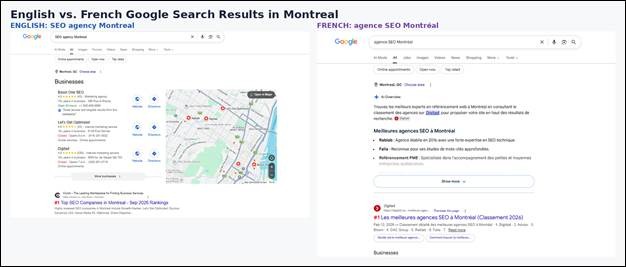
Many generic Google Business Profile guides overlook one of the most important realities of marketing a business in Montreal: customers search in both English and French. The terminology used to describe the same product or service can differ between languages, and a direct translation does not always reflect how people actually search.
Google Business Profile cannot carry that entire bilingual strategy on its own. The website connected to the profile needs to continue the experience. If a French-speaking customer discovers a business through local search and reaches a website with thin, awkward, or incomplete French content, the profile may have earned the click while the website loses the customer.
For businesses genuinely serving both audiences, French pages should be localized for the market rather than treated as mechanical copies of English pages. Service terminology, location context, metadata, page content, and the conversion journey should make sense to the audience using that language.
This is why Google Business Profile optimization and local SEO in Montreal need to work together. The objective is not simply to appear in a bilingual market, but to provide a coherent search-to-conversion experience for the audiences the business actually serves.
7. Use Photos That Help Customers Make a Decision
Photos are useful when they answer questions customers naturally have about a business. A restaurant customer may want to see the food and dining space, someone choosing a contractor may want examples of completed work, and a first-time visitor to a clinic may want to recognize the location before arriving.
Depending on the business, useful profile images can include the exterior, interior, team members, products, completed projects, service delivery, facilities, logo, and branding. Images should be current and genuinely representative of what customers can expect.
Avoid relying entirely on generic stock images or heavily altered photos. The purpose is not simply to fill the photo section. Authentic visuals can reduce uncertainty and help customers evaluate the business while they are still comparing local options.
Get a Free 15-Minute Local Visibility Review
If your Montreal business is not getting the visibility or customer actions you expect from Google Search and Maps, OptiWeb Marketing offers a free 15-minute review to identify gaps in your Google Business Profile and wider local search presence.
Book Your Free 15-Minute Review
8. Create a Consistent Review Process
Reviews influence how customers perceive a company before making contact, and Google also identifies review count and positive ratings as factors that can contribute to local prominence. Reviews therefore matter for both reputation and the wider local search picture.
Rather than waiting passively for feedback, businesses can build legitimate review requests into the normal customer journey. A direct review link after a completed service, a follow-up email, or a natural request from a customer-facing team member can make it easier for satisfied customers to share their experiences. Reviews should always be genuine. Buying reviews or manufacturing feedback creates unnecessary risk and undermines the trust the review system is meant to provide.
Businesses should also respond to reviews. Repeating the same “Thank you for your review” under every comment adds little value, while a brief response that acknowledges the customer’s actual experience feels more genuine. Negative feedback should be handled professionally without becoming defensive or exposing sensitive details publicly. The response is not only for the reviewer. Potential customers may read it later to understand how the company handles problems.
Follow a Consistent and Compliant Review Process
Ask customers for reviews as part of a consistent process, but do not offer discounts, gifts, or other incentives in exchange for a review. Businesses should also avoid review gating, where only customers expected to leave positive feedback are encouraged to post publicly while others are directed elsewhere.
For Montreal businesses serving customers in both English and French, language matters as well. When possible, reply in the same language the customer used in their review. This creates a more natural customer experience and helps the profile reflect the bilingual audience the business serves.
9. Keep the Profile Current and Deal With Update Problems Properly
Google Business Profile optimization is not a one-time setup because businesses change. Opening hours, holiday schedules, services, photos, temporary closures, and other customer-facing details need to change with them.
For a Montreal business, outdated hours can have an immediate real-world consequence. A customer may see that the location is open, travel there, and discover that the information was wrong. At that point, the problem is no longer simply an SEO issue. It has created a poor customer experience and potentially lost a sale or enquiry.
Google also reviews Business Profile edits, which means some changes may not appear immediately. If you have already corrected information but the update remains pending, is rejected, or does not appear as expected, our article on Google
Business Profile changes not saving explains common causes and what businesses should check next.
Regularly reviewing the live profile is therefore just as important as making the initial optimizations. Do not assume that information remains accurate simply because it was correct when the profile was first configured.
10. Understand the Shift From Google Business Profile Q&A to AI Answers
Google has been moving away from the traditional Business Profile Q&A experience toward AI-generated answers about places. Instead of relying only on customers browsing existing questions and answers, Google is increasingly using business information, reviews, contributions, and other relevant sources to answer questions about places.
Google has also introduced Ask Maps, a conversational experience powered by Gemini that allows users to ask detailed questions about businesses and places. As of this guide’s latest update, Google has announced Ask Maps availability in select markets, including the United States and India, but Canada-wide availability has not been officially confirmed.
For Montreal businesses, the practical takeaway is to keep Business Profile information, reviews, services, hours, photos, and website content accurate and consistent. As Google’s local search experience becomes more AI-driven, clear and reliable business information gives its systems stronger information to work with.
11. Make the Website and Business Profile Reinforce Each Other
One of the most common local SEO mistakes is treating the Business Profile as a replacement for website optimization. It is not. Google can use information from multiple sources when understanding and displaying business information, including publicly available information from the company’s official website.
The website should reinforce the services, locations, contact details, and other important information presented through the profile. It should also provide the depth that cannot fit inside a Business Profile, including detailed service pages, useful location content, supporting resources, and English and French experiences where relevant.
Technical problems can weaken that foundation. If important pages cannot be indexed correctly, redirects are broken, site structure is confusing, or search engines struggle to understand key pages, repeatedly editing the Business Profile does not solve the underlying issue. A technical SEO audit can identify indexing, canonicalization, redirects, structured data, performance, and other technical issues that may be limiting the website supporting your local search presence.
The same principle applies to content. If a company wants to appear for a particular service in Montreal but its website barely explains that service, the Business Profile cannot create all of the missing relevance on its own. The website and profile should communicate a consistent picture of what the business offers and where it operates.
12. Strengthen Local Authority Beyond Google Business Profile
Google Business Profile is important, but local SEO does not happen entirely inside the profile. Google’s explanation of local prominence includes information from across the web, such as links and reviews, which means a company’s wider local presence also deserves attention.
Relevant local and industry directories, accurate business listings, industry associations, local media coverage, partnerships, quality backlinks, and consistent business information can all contribute to a stronger overall presence. The goal is not to submit the company to every directory available simply to increase the number of citations. Prioritize credible sources that make sense for the industry and the geographic market.
For businesses working on this broader foundation, our guide to local SEO strategies for businesses covers additional considerations that work alongside Business Profile optimization, including website optimization, reviews, mobile experience, and local authority.
For Montreal companies in particular, genuine relevance to the communities and industries they serve is more valuable than creating a large number of low-quality listings with little connection to the actual business.
13. Measure Business Actions, Not Rankings Alone
Appearing more prominently in Maps or local search is useful, but ranking itself is not the business objective. The real question is what relevant customers do after they find the company.
Depending on the information available for the profile and website, useful performance indicators can include website visits, calls, direction requests, bookings, enquiries, local organic traffic, review growth, leads, and conversions. Looking at these actions provides a better picture of whether improved visibility is producing business value.
At OptiWeb Marketing, we look beyond whether a business moved for an individual keyword. A company can gain visibility without generating better leads, attract traffic to the wrong pages, or appear for searches that do not match its services. Local SEO measurement should help distinguish useful visibility from activity that looks good in a ranking report but contributes little to growth.
Real-World Local SEO Example
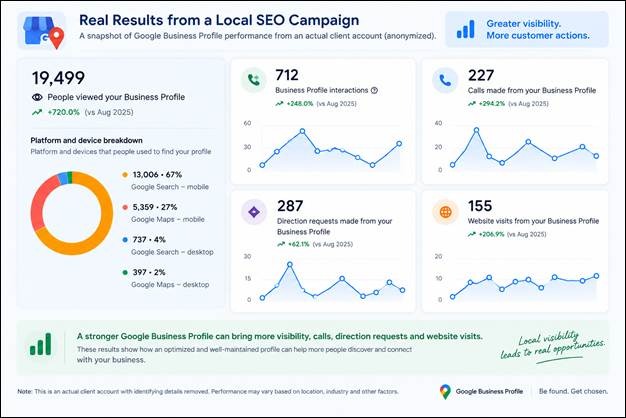
A service-based business was struggling to generate stronger visibility and customer actions through its local search presence. OptiWeb Marketing worked on improving its local SEO foundation, including its Google Business Profile presence and the supporting signals that help customers discover and engage with the business.
The performance data shown here reflects the resulting growth in profile visibility and customer interactions, including calls, direction requests, website visits, and other actions from local search.
Common Google Business Profile Mistakes to Avoid
Some of the most common issues we see include:
- Using an inaccurate business name or adding unnecessary keywords to it.
- Selecting categories that do not accurately represent the business.
- Leaving services, products, attributes, hours, or other important profile details incomplete.
- Using an address incorrectly for a service-area business.
- Allowing outdated business information to remain on the profile.
- Offering incentives for reviews or using review-gating practices.
- Ignoring customer reviews or responding inconsistently across English and French audiences.
- Relying on the Business Profile while neglecting the website and broader local SEO strategy.
- Failing to monitor profile changes, customer actions, and other performance signals over time.
Each of these issues can weaken the accuracy, usefulness, or customer experience of the profile. Regular reviews help ensure the information customers see in Google Search and Maps continues to reflect how the business actually operates.
Google Business Profile Optimization Checklist
Use this checklist when reviewing your Google Business Profile:
☐ Business name matches the real-world business name
☐ Address or service area is accurate
☐ Phone number and website URL are current
☐ Regular and special business hours are updated
☐ Primary category accurately represents the core business
☐ Relevant secondary categories are selected
☐ Services, products, and applicable profile attributes are complete
☐ Business description is accurate and written for customers
☐ Current, authentic photos are uploaded regularly
☐ Reviews are requested without incentives or review gating
☐ Customer reviews receive appropriate responses
☐ Booking or appointment links lead to the correct page, where applicable
☐ English and French customer experiences are properly supported where relevant
☐ Business Profile information is consistent with the website
☐ Profile performance and customer actions are reviewed regularly
Want a copy for your team? Download the Google Business Profile Optimization Checklist PDF and use it during your next profile review.
Where Should a Montreal Business Start?
Start with an audit rather than making random profile changes. Review what customers currently see when the business appears in Google Search and Maps, compare that information with the website and important external listings, and identify where details are missing, inconsistent, outdated, or disconnected from the services and locations the company actually wants customers to find.
From there, prioritize the issues affecting relevance, customer trust, and the journey from local search to enquiry. At OptiWeb Marketing, our Local SEO services in Montreal look beyond the Business Profile itself. We review the profile, website, business information, reviews, local targeting, content, and technical foundation to identify where visibility is being lost and which improvements deserve priority.
If your business is struggling to appear for relevant local searches or your Google Business Profile is not generating the enquiries you expect, contact OptiWeb Marketing. We can review your current local search presence, identify the gaps affecting visibility and customer journeys, and build a prioritized strategy across your Google Business Profile and website.
For a closer look at how we approach search visibility and digital growth for our clients, explore our case studies and see the strategies behind our work.
 Table of Contents