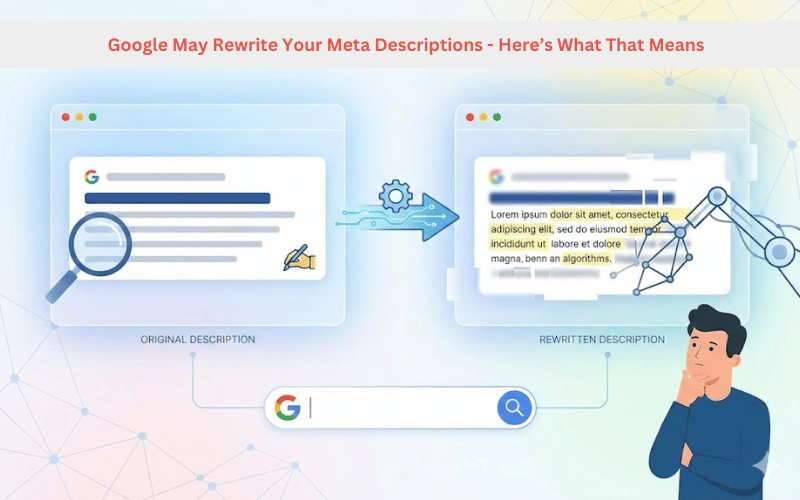
If you spend time optimizing your website, you’ve probably crafted your meta descriptions with special care. These little snippets are what show up under your site title in search results. You want them to be just right: catchy, relevant, helpful, and designed to attract clicks. But lately, you might have noticed that Google does not always use the meta description you wrote. Sometimes, it changes it altogether. Why does this happen, and what does it mean for your website, especially if you are getting help from an internet marketing agency? Let’s dig into the details.
What Are Meta Descriptions, and Why Do They Matter?
Meta descriptions are short pieces of text that summarize the content of a web page. If someone looks up a topic and your page appears on Google, this is the short blurb they will see. Ideally, meta descriptions should provide a clear overview of what to expect if the user clicks the link. They are a chance to make a first impression, and a good one can improve your search traffic.
For years, marketers and business owners have focused on writing strong meta descriptions as part of their everyday SEO efforts. An experienced internet marketing agency will often stress the importance of these snippets, knowing how much they can impact click-through rates and user trust.
Why is Google Rewriting Meta Descriptions?
Google’s main job is to serve the most helpful and relevant search results to users. That does not just mean giving the right web pages, but also presenting the most relevant snippets of information in the search listing. Sometimes, Google’s algorithms decide that the meta description provided by a website is not the best option for the user’s search intent or query.
Several factors can cause Google to generate a new description:
- The meta description does not match the content on the page.
- The meta description is missing or too generic.
- The user’s search term does not appear in your written snippet, but it does appear elsewhere on your page.
When this happens, Google might pull a sentence or two directly from your page content. If your original was created with AI SEO tools or manually written, Google may still decide that a different summary serves the searcher better.
Not sure if Google is rewriting your meta descriptions?
Our SEO team analyzes your metadata and search snippets to ensure your pages display correctly and attract higher click-through rates.
Enter AI: Changing the SEO Game
With search engines getting smarter, AI based SEO is now a growing trend. Many businesses and agencies rely on AI SEO tools to analyze data and optimize everything from keywords to headlines and, of course, meta descriptions. AI generated descriptions can speed up the process, make sure updates happen regularly, and help with ideas you might not think of on your own.
However, just because you use AI generated descriptions, there’s no guarantee Google will use them. Sometimes, artificial intelligence may produce perfectly technical but slightly robotic summaries that don’t feel quite as natural as a human-written sentence. If Google picks up on this, it may automatically pull more user-focused content from your actual page to display instead. This is where a balance between automation and human touch becomes very important.
AI Metadata and AI Generated Summaries
AI can do more than just meta descriptions. Today, AI metadata creation tools help build the behind-the-scenes info for your web content, making it easier for search engines to understand and display your pages. Likewise, an AI generated summary can help you quickly draft those SEO snippets. Still, whether you use these smart solutions or not, always review what appears in search listings because Google can, and does, make changes as it sees fit.
Should You Worry as a Website Owner?
It can feel frustrating when you carefully write something, and Google decides not to show it. However, there’s a positive side. Google’s rewrites are usually intended to help your site perform better in search. If the search engine believes another snippet from your content will be more helpful for the person searching, it can lead to higher engagement.
Instead of worrying, use this as an opportunity to review both your site and your strategy. Look at what Google displays for your main pages and consider why the search engine might have switched things up. An internet marketing agency can help you analyze these differences and guide you on how to write descriptions that are both enticing for visitors and closely related to your actual content.
How to Adapt Your SEO Strategy
You can’t force Google to use your meta description every time, but you can improve the likelihood. Here are some practical tips:
- Make sure your meta description closely matches the page’s main topic and keywords.
- Avoid being too generic or stuffing it with random keywords.
- Ensure it answers a potential question the user might have.
- Keep it at an ideal length (about 156 to 160 characters).
- Use AI SEO tools for ideas and efficiency, but always fine-tune your text so it reads well and genuinely matches your content.
- Monitor your search results to see what Google is displaying and rethink your descriptions if you see too many rewrites.
Remember, the role of AI in SEO is to support your workflow, not replace the human brain entirely. A blend of smart tools and a real understanding of your brand and audience can help you produce meta descriptions and AI generated summaries that are both smart and authentic.
The Human Touch Still Matters
Even as AI becomes more powerful and the use of AI based SEO grows, the personal touch is still crucial in digital marketing. Machine suggestions are great for scaling content and getting started quickly, but it’s up to you or your internet marketing agency to make sure everything is on brand and audience-focused. That applies to meta descriptions, AI metadata, and every other on-page element.
Looking Ahead: What Google’s Changes Mean for SEO
The search landscape is always evolving. Google’s willingness to rewrite meta descriptions means that site owners must pay extra attention to on-page content and overall user experience. Clear, helpful, and well-organized information on your page will make it easier for Google to generate good snippets even if those are not the ones you wrote.
Using AI SEO tools and investing in AI generated descriptions gives you a competitive edge, but do not rely solely on automation. Always combine these results with manual reviews. Make your main content as informative and easy to read as possible, since that’s where Google might pull snippets if it decides to override your meta tag.
Final Thoughts
Don’t panic if Google rewrites your meta descriptions. Instead, see it as feedback and a chance to do better for your visitors and your rankings. Keep your focus on clarity, honesty, and genuine value for your audience. Continue updating your skills, whether you’re doing your own SEO or working with an internet marketing agency, and stay up to date with new trends, particularly in AI based SEO.
Embrace AI SEO tools to help refine your process, create effective AI generated summaries, and improve your overall metadata strategy. In the end, Google’s goal is not to make your life harder, but to connect users with the content and answers they want. By working hand-in-hand with both technology and best content practices, you can take every algorithm change in stride and keep growing your online presence.
Want your search listings to look better on Google?
We help optimize your titles, meta descriptions, and on-page content so Google shows more accurate and compelling snippets.
 Summary