How Google’s JavaScript Update Affects SEO?
Google has quietly but significantly updated its JavaScript SEO documentation, adding clearer guidance on how canonical content should be handled on JavaScript-rendered websites. While the update may appear subtle at first glance, it directly affects how Google crawls, renders, and indexes modern websites built with JavaScript frameworks such as React, Vue, Angular, and headless CMS platforms.
For businesses, developers, and internet marketing agencies across Canada and the United States, this update is significant. Many websites now rely on JavaScript to dynamically generate metadata, including canonical tags. Google’s updated documentation clarifies how conflicting canonical signals can occur and how to prevent them before they negatively impact search visibility.
This guide explains what changed, why it matters, what Google did not explicitly say, and how to align your canonicalization content strategy with modern JavaScript SEO best practices.
Why Google Updated Its JavaScript SEO Documentation?
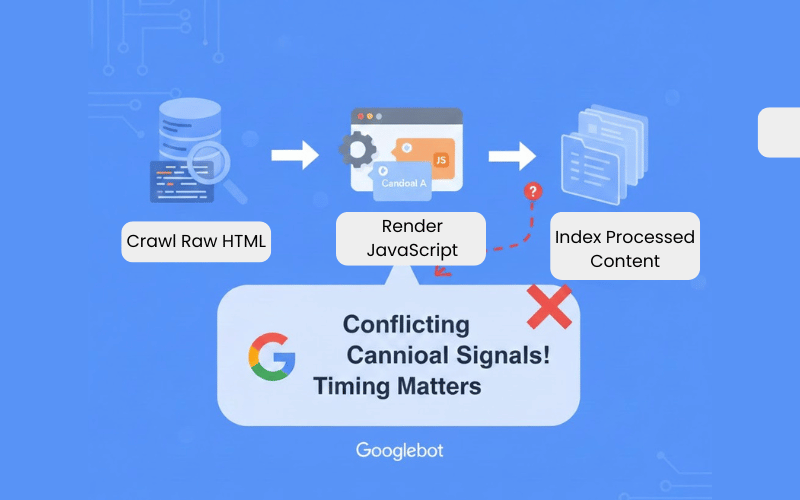
Google processes JavaScript websites in multiple stages. First, it crawls the raw HTML. Then it renders the page using JavaScript. Finally, it indexes the processed content. Until now, Google acknowledged that canonical tags could be modified by JavaScript, but it did not clearly explain how timing differences between raw HTML and rendered output could create conflicting canonical signals.
The updated documentation now makes this explicit.
Google confirms that:
- Canonicalization can occur before rendering and after rendering
- Google may see two different canonical URLs if JavaScript modifies them
- Conflicting canonicals can lead Google to ignore your preferred version
This clarification is meant to help site owners avoid unintentional indexing issues, especially on JavaScript-heavy sites common in SaaS, eCommerce, and enterprise marketing websites across North America.
Understanding Canonical Content in JavaScript SEO
What Is Canonical Content?
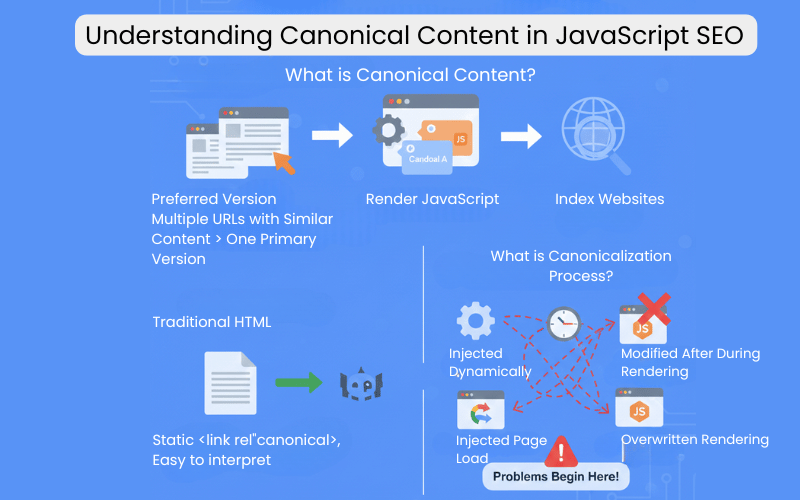
Canonical content refers to the preferred version of a webpage that you want search engines to index when multiple URLs contain similar or identical content.
What Is Canonicalization Content?
Canonicalization content is the process and signals used to tell search engines which version of a page should be treated as the primary one. This is usually done using the <link rel=”canonical”> tag.
In traditional HTML websites, canonical tags are static and easy for search engines to interpret. In JavaScript-rendered websites, canonical tags can be:
- Injected dynamically
- Modified after page load
- Overwritten during hydration or client-side rendering
This is where problems begin.
What Exactly Changed in Google’s Guidance
Google’s New Canonical Advice for JavaScript Sites
Google now recommends:
- Canonical tags should be consistent in both raw HTML and rendered HTML
- Avoid changing canonical URLs via JavaScript unless necessary
- If JavaScript must set the canonical, consider not including a canonical in the initial HTML
- Ensure that only one canonical URL remains after rendering
This guidance exists to prevent Google from receiving mixed signals that could result in the wrong page being indexed.
What Google Did Not Explicitly Say (But SEO Professionals Should Understand)
This is where most articles stop; however, for SEO professionals and web marketing services targeting competitive markets like Canada and the US, deeper interpretation matters.
1. Server-Side Rendering Is Still the Safest Option
Google does not explicitly say “always use server-side rendering,” but the implication is clear. Canonicals present in raw HTML are processed earlier and more reliably than JavaScript-injected ones.
2. JavaScript Hydration Can Overwrite Canonicals
In hybrid setups where server-rendered HTML is hydrated by JavaScript, canonical tags can accidentally change during hydration. This is a common issue in headless CMS and React-based frameworks.
3. Canonical Conflicts Can Delay Indexing
When Google sees conflicting canonical signals, it may:
- Delay indexing
- Choose a different canonical
- Ignore canonical tags altogether
This can be especially damaging for time-sensitive pages, campaign landing pages, and large eCommerce catalogs.
JavaScript SEO Basics: According to Google
Google’s JavaScript SEO basics explain how search engines process JavaScript websites.
How Google Handles JavaScript?
- Crawls the raw HTML
- Queues the page for rendering
- Executes JavaScript using Chromium
- Indexes the final rendered output
If key SEO signals like canonical tags, internal links, or content only appear after rendering, Google must wait for the second wave of processing. This introduces risk and inconsistency.
For businesses relying on organic traffic, especially in competitive US and Canadian markets, this delay can impact rankings and crawl efficiency.
Canonical Handling Comparison Table
| Scenario | Raw HTML Canonical | Rendered Canonical | SEO Risk |
| Static HTML site | Same | Same | Low |
| JS site with consistent canonical | Same | Same | Low |
| JS site changing canonical | Different | Different | High |
| No canonical in HTML, JS sets it | None | One | Medium |
| Multiple canonicals after render | Conflicting | Conflicting | Very High |
Practical Canonical Implementation Checklist
For website owners and internet marketing agencies:
- Ensure canonical tags exist in raw HTML wherever possible
- Avoid modifying canonical URLs dynamically via JavaScript
- Test rendered output using Google Search Console URL Inspection
- Compare view-source HTML vs rendered DOM
- Validate canonical URLs across paginated, filtered, and parameter-based pages
- Document canonical rules for developers and content teams
This checklist is especially valuable for organizations offering web marketing services with ongoing development cycles.
Industry-Specific Impact Examples
For eCommerce Websites
Incorrect canonical handling can cause:
- Product variants to outrank main product pages
- Filtered URLs get indexed unintentionally
- Loss of consolidated ranking signals
For SaaS and Tech Companies
Dynamic routing and client-side navigation can:
- Generate multiple URLs for the same content
- Cause Google to index staging or parameter URLs
For Marketing and Agency Websites
Landing pages built with JavaScript may:
- Lose canonical consistency during campaign updates
- Compete with blog or resource pages unintentionally
Why This Update Matters for Canada and US Businesses?
Search competition in Canada and the US is highly saturated. Small technical missteps can result in:
- Lost rankings
- Reduced crawl efficiency
- Lower organic ROI
Google’s updated guidance reinforces the importance of technical SEO alignment between developers and marketing teams. Businesses that adapt early will maintain stronger indexing stability and search performance.
Final Thoughts
Google’s updated JavaScript SEO documentation reinforces a key principle: canonical consistency matters more than ever. As websites become increasingly dynamic, SEO success depends on aligning development decisions with search engine expectations.
For businesses and internet marketing agencies in Canada and the United States, this update is not just technical guidance. It is a reminder that strong SEO today requires collaboration between marketing, development, and content teams.
If your site relies on JavaScript, now is the time to audit canonical content, validate rendered output, and future-proof your SEO strategy.
 Summary