Over the past few months, many Canadian businesses have experienced something frustrating.
Traffic is down.
Rankings look stable.
Impressions are steady.
But clicks are lower.
If that sounds familiar, you are not alone.
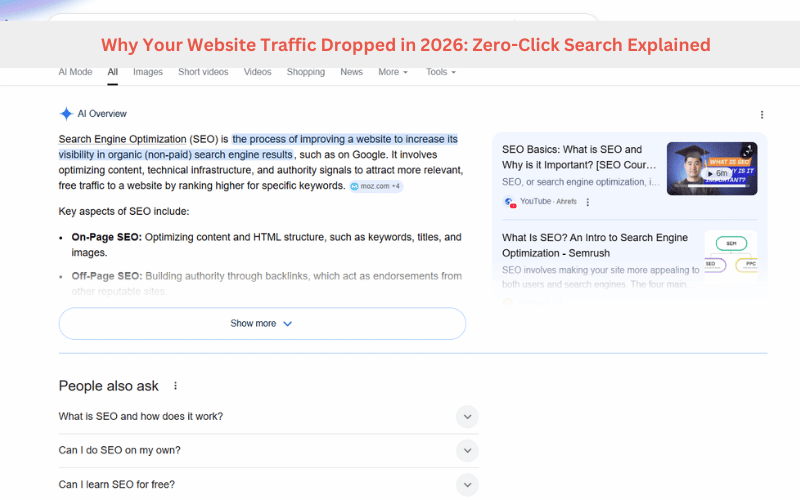
This is one of the biggest shifts we are seeing in 2026, and in many cases, the problem is not poor SEO. It is something called zero-click search, powered largely by Google’s AI Overviews.
Understanding what is happening is the first step toward fixing it.
What Zero-Click Search Really Means in 2026
A zero-click search happens when someone searches on Google, finds the answer directly on the results page, and leaves without clicking on any website.
In the past, this mostly happened with simple queries like weather, definitions, or quick facts.
In 2026, it will happen with much deeper questions.
Google’s AI Overviews now generate full summaries at the top of the page. These summaries often answer the user’s question clearly enough that they do not need to visit a site at all.
For example, if someone searches:
- Why did my website traffic drop?
- How does SEO work in Canada?
- What is local SEO?
Google can now generate a structured explanation using information from multiple websites.
The result is this: even if your content is excellent and ranking well, the user may never click.
That does not mean your SEO failed. It means search behavior has evolved.
Why Rankings Are No Longer the Full Story
For years, SEO was straightforward. Rank higher, and you get more traffic.
In 2026, ranking alone is not enough.
We are seeing situations where a page ranks in position one or two, yet traffic is down compared to last year. When we dig deeper into Google Search Console, the pattern becomes clear:
Impressions remain steady.
Average position barely changes.
CTR declines.
That drop in click-through rate is often the real issue.
AI Overviews, featured snippets, People Also Ask boxes, and local packs are taking up more space on the page. Organic listings are pushed further down. Even position one may appear below an AI summary, a map pack, and a set of related questions.
In practical terms, your listing may technically rank first, but visually, it is not the first thing users see.
This is especially noticeable in informational searches, which many agencies rely on for blog traffic.
Why Informational Content Is Most Affected
Commercial keywords such as “SEO company in Montreal” or “digital marketing agency Canada” still generate clicks because the user is looking to hire someone.
Informational searches are different.
When someone searches for “why traffic dropped in 2026,” they want an explanation. If Google provides a clear AI-generated summary at the top of the page, many users will read it and move on.
That does not mean informational content is useless. It means it must be stronger, deeper, and more experience-driven than what AI can summarize easily.
Generic content is the first thing to lose traffic.
Original insight still earns clicks.
How to Confirm If Zero-Click Is Impacting Your Website
Before changing strategy, confirm what is actually happening.
Open Google Search Console and look at:
- Impressions over the last three to six months
- Clicks over the same period
- Average position
- CTR
If impressions are stable or increasing but clicks are falling, the issue is likely CTR rather than rankings.
Next, manually search your primary keywords in Canada. Do you see AI Overviews appearing? Are there large featured snippets or map packs above your listing?
If the answer is yes, you are competing for attention, not just rankings.
What You Can Do to Recover Traffic
You cannot remove AI Overviews from Google. But you can adapt.
The first shift is understanding that visibility and traffic are now two different metrics. Being mentioned or cited in AI summaries builds authority even if clicks do not happen immediately.
To increase actual clicks, your content must give users a reason to go deeper.
Instead of writing surface-level explanations, add:
- Real client examples from Canadian businesses
- Data from your own campaigns
- Local market insights
- Clear opinions based on experience
AI can summarize general advice. It cannot replicate your real-world results.
If someone reads an AI summary and then sees a title promising detailed recovery steps specifically for Canadian businesses, they are more likely to click.
That is where the title strategy becomes critical.
Improving Click-Through Rate in 2026
Many traffic drops are actually CTR drops.
Look at your titles and ask yourself a simple question. Would you click this?
Titles that still work in 2026 usually:
- Mention the year
- Address a clear pain point
- Suggest a practical solution
- Feel specific rather than generic
For example, instead of writing:
“Zero Click Search Guide”
Write something closer to:
“Why Canadian Businesses Lost Traffic in 2026 and How to Recover It”
That feels relevant, urgent, and location-specific.
Meta descriptions matter more now as well. They should not just repeat keywords. They should explain the benefit of clicking.
If the user already read a summary from Google, your snippet must promise added value.
The Role of Local SEO in Protecting Traffic
One interesting pattern we are seeing across Canada is that local searches remain more resilient.
When someone searches “SEO agency near me” or “digital marketing company Montreal,” they are not looking for an explanation. They are looking for a provider.
Local intent still drives clicks.
This is why strengthening your local SEO signals is more important than ever. Optimized Google Business Profiles, local backlinks, Montreal-focused landing pages, and review generation all help maintain click-based traffic.
Informational SEO builds authority.
Local SEO drives conversions.
You need both.
The Bigger Picture: Search Has Changed Permanently
Zero-click search is not a temporary trend.
AI-powered results are now part of Google’s long-term direction. That means SEO strategies built purely around ranking blog posts for informational keywords will struggle over time.
Working with an experienced SEO agency can help you adapt your strategy before rankings slip.
The focus moving forward should be:
- Authority over volume
- Depth over surface-level content
- Experience over repetition
- Intent-driven content over broad traffic chasing
Traffic drops can feel alarming. But often they are signals that the search landscape shifted, not that your work failed.
Businesses that adapt their content strategy, strengthen their local presence, and improve CTR will recover and grow.
Those who continue publishing generic blog posts will see diminishing returns.
Final Thoughts
If your website traffic dropped in 2026, start by diagnosing the real cause. Look at impressions, CTR, and SERP features before assuming rankings are the issue.
Zero-click search is reshaping how users interact with Google. The solution is not to publish more content. The solution is to publish better, more strategic content that gives users a reason to choose your website over an AI summary.
SEO is not disappearing.
It is evolving.
And businesses that understand this shift early will gain a competitive advantage in Canada’s increasingly AI-driven search landscape.
 Summary